





At 9 months old, your baby no longer has much in common with the newborn of the first few weeks. They crawl, pull themselves up to stand by holding onto furniture, pick up the tiniest objects with formidable precision, understand part of what you say to them, and clearly express their emotions — including anger when someone takes their favourite toy. They are a little explorer in full development, and the choice of developmental toys for 9-month-old baby is becoming more strategic than ever.
At this age, needs change rapidly. The toys that fascinated them at 6 months now seem dull, whilst those designed for older children are still too complicated. At PetitMaxou, we’ve put together this guide with an educational approach: to understand where your baby is at so you can choose the right toys at the right time — without ending up with too many.
At 9 months old, what can your baby do?
Before choosing a toy, you need to understand the new skills being acquired at this age. Around 9 months, most babies:
- Move on all fours, crawling or shuffling on one's bottom
- Stand up leaning on a piece of furniture, and starting to «cruise» from one support point to another
- Use fine tweezers (thumb + index finger) for picking up small objects with precision
- Contain several words their first name, «no», «daddy», «mummy», «goodbye»
- Imitate sounds and gestures wave goodbye, clicking noises with the mouth, repeated first syllables («ba-ba», «ma-ma»)
- Have mastered object permanence a toy hidden under a scarf still exists, and they go looking for it
- Show signs of separation anxiety they can't bear to let their parents out of their sight, even for a few seconds
- Actively exploring open, close, empty, fill — everything goes through the mincer of their little curious hands
Each of these acquisitions paves the way for a specific type of toy. Let's take a look at which ones.
The 4 major acquisitions at 9 months and the toy that goes with it
1. Movement: push and pull toys
At 9 months old, baby won't stay still. They crawl, pull themselves up, and try to go everywhere. This new mobility radically changes their relationship with play: they now want reach objects, rather than simply manipulating them from a seated position.
The push toys (baby walkers, weighted balls, lightweight cars) encourage movement and quickly become objects of desire. Some babies also start to take an interest in the first pull toys on a string, even though they will truly master them around 12-15 months.
It is also the ideal age for a baby walker stable and heavy, offering real support for those first assisted steps. Avoid models that are too light and slide away under the hands, which can cause falls. Check for wheels with brakes or an adjustable grip system.
2. The pincer grasp: toys requiring fine manipulation
The pincer grasp — the ability to pick up an object between the thumb and index finger — develops gradually between 8 and 12 months. It is a major cognitive and motor milestone: it lays the groundwork for writing, independent feeding, and thousands of everyday actions.
There are many toys that stimulate her. The shape sorters require gripping parts and turning them — a real challenge at 9 months. The stacking cubes and the wooden towers call for precision. The simple inset puzzles (large pieces, few places) are perfect to start with.
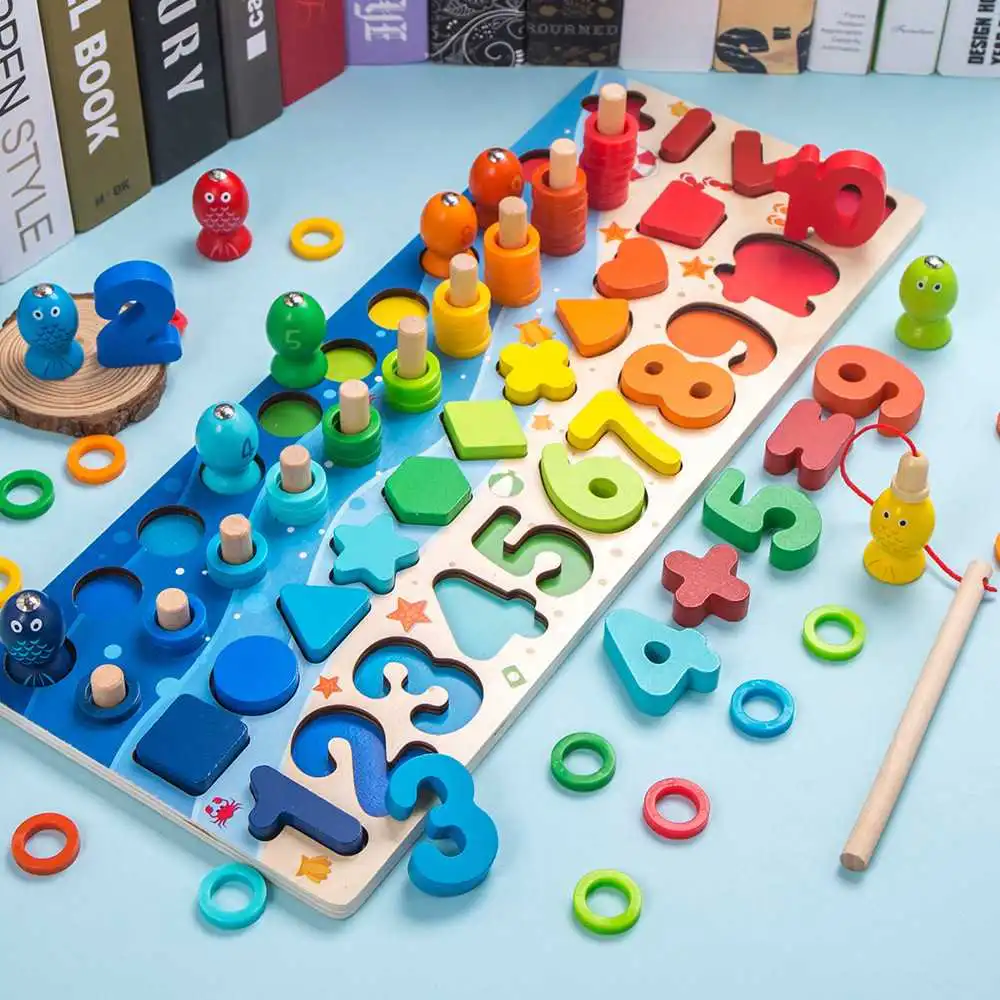
Not to be overlooked: toys with small items to handle fixed to a base — busy boards, sensory boards, wooden Montessori toys. They allow children to practise the pincer grip without any risk of ingestion, as the pieces remain attached.
3. Imitation and understanding: the first role-play toys
At 9 months old, a baby is like a sponge. They observe everything, imitate more and more, and are beginning to understand the social use of objects. The telephone, the spoon, the hairbrush — they already know what they are for, even if they handle them clumsily.
The simple pretend toys are a real hit at this age: toy phones, small brushes, mirrors, soft dolls. The safety mirror becomes particularly fascinating — baby starts to recognise their own reflection and interact with it.
The hardback books also play a full part. At 9 months old, babies love turning pages (large, thick ones), pointing at pictures and hearing the same stories over and over again. The bedtime story ritual can be established right now and become a cornerstone of going to sleep.
4. Object permanence: hide-and-seek toys
Object permanence, which begins around 6 months, is now firmly established. Baby knows that a hidden toy continues to exist, and will actively search for it. This is the golden age of peekaboo games, surprise boxes and toys to open and close.
The stacking and dismantling toys, the boxes with lids, the Russian dolls simple, they strobe toys Jack-in-the-boxes are delightful at that age. They combine motor pleasure (manipulating) with cognitive pleasure (understanding that the object disappears and then reappears).
It is also a good time to introduce the first surprise plush toys (animals in an egg, toys hidden in a pocket) — they develop both object permanence and imagination.
Our selection of tested toys for 9-month-old babies
At PetitMaxou, we organise our product ranges into broad categories to help you choose according to your current needs:
Gross motor skills
Stable baby walkers, weighted balls, play tunnels, motor skill mats. These toys support progress in movement and preparation for walking. They also contribute to baby's self-confidence as they experiment with their new abilities.
Fine motor skills
Shape sorters, stacking cubes, Montessori activity boards, sensory boards. These toys develop the pincer grasp, hand-eye coordination and concentration. They remain relevant up to 18-24 months.
Cognitive awakening
Board books, peekaboo toys, first inset puzzles, pop-up toys. They stimulate the understanding of cause and effect, memory and problem-solving.
Imitation and language
Toy phones, safe mirrors, soft dolls, simple sound books. They accompany early words, early imitations and language development.
9-month developmental toy for a girl or boy: should we really make a distinction?
No, no more than at 6 months. The developmental milestones at 9 months are identical in girls and boys: the same development of the pincer grasp, the same ability to pull up to a standing position, and the same growing understanding of language. The brain of a 9-month-old baby does not develop differently according to sex.
Pink/blue marketing differentiation is a social construct, not a pedagogical necessity. If you are giving a gift and the parents have an aesthetic preference, you can obviously take that into account. But a natural wood block, a board book or a baby walker will interest all babies of that age — regardless of their name.
If you are looking for a original gift for a 9-month-old baby, focus on developmental relevance and the quality of the materials. That is what makes the difference between a toy that ends up at the bottom of a box and one that will shape months of learning and discovery.
The Montessori approach at 9 months: autonomy and precision
The Montessori approach really comes into its own at 9 months, an age when the baby starts to show a real desire for independence. A few principles to apply:
- Encourage choices offer 2 or 3 toys at a time, not the whole box. Baby chooses what interests them, concentrates on it, and develops cognitive independence.
- Choose natural materials wood, organic cotton, food-grade silicone. They offer richer and more authentic sensations than standard plastic.
- Avoid over-stimulation toys that light up, make sounds and vibrate all at the same time tire baby out without helping them progress. One stimulus at a time.
- Embrace repetition Is baby repeating the same action 50 times in a row? It's normal, and even essential. They are consolidating a new skill.
- Respect their concentration When baby is absorbed by a toy, do not intervene. Do not ask questions, do not comment. Let them dive in.
This approach does not require specific «Montessori-certified» toys — it mainly requires a change in perspective regarding free play and baby's abilities.
Safety: the 5 toy traps to avoid for 9-month-olds
At 9 months, baby's mobility changes everything. They can reach places they couldn't reach at 6 months, put absolutely everything in their mouth, and start climbing. Safety requires increased vigilance:
- Mandatory CE marking — as for all previous ages
- No small detachable parts - test it with a toilet roll. At 9 months, a baby has the manual dexterity to take apart seemingly solid assemblies
- Stable, weighted baby walkers — overly light models slip out of your hands and cause falls
- No long cords or accessible ribbons — more than ever, baby gets tangled everywhere
- Be careful with the toys he can get out by himself - he opens drawers, empties baskets, and reaches items outside of his official toy box
Take the opportunity to make the environment safe as well: plug socket covers, furniture corner guards, drawer locks, stair gate. At 9 months old, baby goes everywhere — your home must adapt.
When to introduce each developmental toy?
To help you navigate the evolution of baby's needs:
- 3 months play mats, lightweight rattles, high-contrast fabric books, play arches. (Discover our guide 3 month baby developmental toy.)
- 6 months nesting blocks, teething rings, musical activation toys. (See our guide 6-month baby development toy.)
- 9 months baby walkers, shape sorters, push toys, board books, first role-play toys — baby explores on the move.
- 12 months ride-ons, pull toys, first peg puzzles, social role-play toys, picture-rich books. (See our guide 12-month baby developmental toy.)
At every stage, previous toys remain relevant. A shape sorter used at 9 months will continue to amuse baby at 12 months and beyond — simply, new types of play enrich the possibilities.
Frequently asked questions about the 9-month baby development toy
What is the best toy for a 9-month-old baby?
There is no universal answer, but if we had to choose three: a stable baby walker (for gross motor skills), a simple shape sorter (for fine motor skills and cognition), and a few board books (for language and routine). This trio covers the essential needs for this age.
Should you buy a baby walker at 9 months?
Yes, if baby shows clear signs of wanting to stand up and move around. No, if they are still comfortable sitting down and are not trying to pull themselves up. The baby walker supports a need, it does not create one. Avoid baby walkers (sitting in a harness) which are discouraged by most paediatricians — favour push-along baby walkers that baby pushes while standing.
My 9-month-old baby isn't crawling yet. Is that worrying?
No, unless advised otherwise by a doctor. Some babies crawl at 6 months, others at 10 months, and some never crawl and go straight to walking. As long as baby is moving (rolling over, shuffling, trying to pull themselves up), motor development is taking place.
Are audio books useful at 9 months?
Yes and no. A simple sound book (one sound per page, linked to an image) can enhance understanding and stimulate attention. But beware of books with loud music, artificial voices and multiple buttons — they over-stimulate rather than engage. Classic board books, with clear images and little text, remain the best media at this age.
How to keep a 9-month-old baby occupied without a screen?
Screens are strongly discouraged before the age of 3 by most paediatricians. At 9 months old, a baby needs manipulation, movement, and human interaction. Toy rotation, floor time, reading stories, songs and nursery rhymes, peek-a-boo games, safe exploration of the home—this is the real developmental programme.
Is it possible to give a 9-month developmental toy as a gift?
Absolutely. It’s even an age often forgotten by loved ones, who give a lot for the birth and the 1st birthday, but less for 9 months. A gift suited to this precise stage is particularly appreciated—baby will use it immediately, not in 6 months.
Our selection of early learning toys for 9-month-old babies at PetitMaxou
At PetitMaxou, every early learning toy is selected by our team of parents based on a single criterion: would we be happy to give it to our own child? Safe materials, developmental suitability, durability, design — nothing is left to chance.
Free delivery throughout the European Union, 14-day returns, secure payment — discover our complete collection and find the toy that will accompany your baby at 9 months and beyond.