





At 6 months, your baby is no longer quite the newborn of the first few weeks. They sit with a little support, deliberately grab objects, put everything in their mouth, laugh out loud and are beginning to understand that their actions have consequences on the world around them. It is a real turning point in their development — and the moment when baby developmental toys 6 months take on their full meaning.
But bear in mind: a 6-month-old baby does not have the same needs as a 3-month-old. Their sensory, motor and cognitive skills have developed. The toys that fascinated them three months ago are no longer enough, and those designed for 12-month-olds are still too complex. At PetitMaxou, we’ve put together this guide to help you make the right choices — taking an educational approach, rather than simply providing a catalogue.
At 6 months, what can your baby do?
Before choosing a toy, you need to understand where baby is at. Here are the major typical milestones around 6 months:
- He can sit up with a little support — her hands are freed to explore
- He catches it voluntarily objects and passes them from one hand to the other
- He puts everything in his mouth — it is his main exploration tool
- The first teeth are coming through (usually between 6 and 10 months)
- He understands cause and effect I press it, it makes a noise
- He recognises his first name and reacts to voice intonations
- He is beginning to grasp object permanence what disappears still exists
Each of these purchases corresponds to a suitable type of toy. Let's see which ones.
The 4 major acquisitions at 6 months and the toy that goes with it
1. Sitting: toys to handle in front of you
Around 6 months of age, baby spends more and more time sitting up. This new posture changes everything: they see the world differently, both hands are free to grab and manipulate things, and they can explore a toy from all angles.
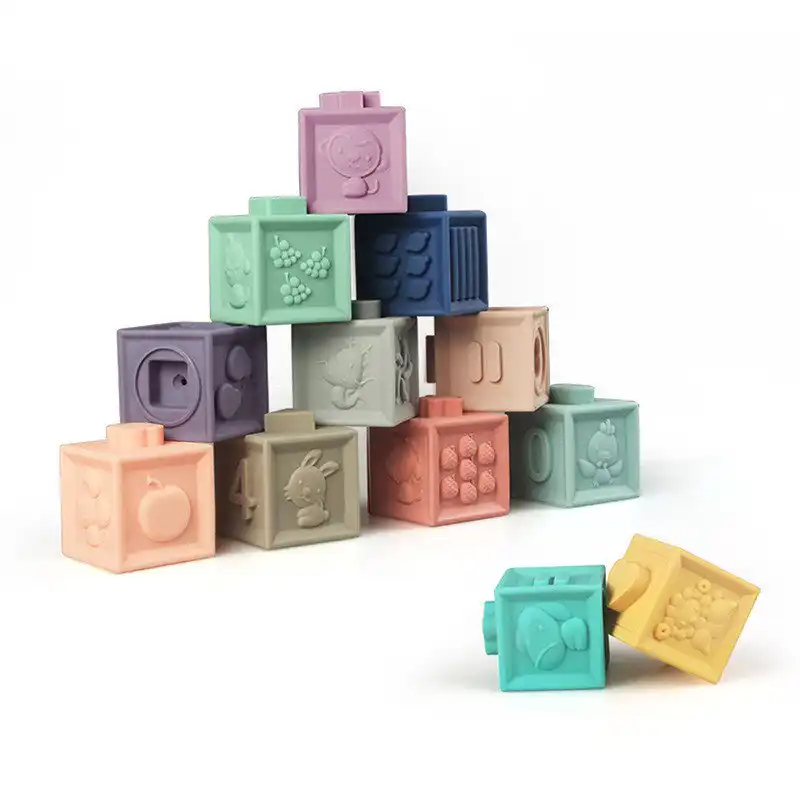
The stacking toys, the nesting blocks and the sensory balls are perfect at this stage. They encourage baby to grasp, turn, let go, start again — essential movements for fine motor skills. The grow-with-baby play mats which offer a seated version with interactive panels around the baby also extend the use of the early-months play mat.
Choose lightweight toys that are easy for small hands to grip and large enough to prevent any choking hazard (minimum diameter of 4.5 cm for any part).
2. The first teeth: teething toys
Teething generally starts between 6 and 10 months, and it can be uncomfortable. Baby drools a lot, bites everything they find, and is sometimes more grumpy than usual. A good teething ring then becomes essential.
The best models are made of food-grade silicone or natural rubber, free from BPA and phthalates. Some can be placed in the fridge (not the freezer) to provide a soothing effect on the gums. The various shapes — smooth, studded, textured — allow baby to massage different areas of their mouth.
Tip: choose a teething ring that also acts as a rattle or has coloured elements. Two functions in one toy.
3. Cause-and-effect understanding: toys that react
At 6 months old, baby begins to understand something fundamental: when I press this button, music plays. When I shake this toy, it makes a noise. This realisation is a major cognitive milestone — and it is fascinating to watch.
The musical toys to activate, simple dimple toys, the sensory rattles easy to handle and balls that squeak or jingle are ideal. They give baby a sense of mastery over their environment — and that is a precious gift for their self-confidence.
A good cause-and-effect toy at 6 months must have an immediate and clear response: the button is big, the music starts right away, the sound is gentle but audible. Toys that are too complex or react too slowly lose baby's interest.
4. Object permanence: hide-and-seek toys
Around 6 to 8 months, baby begins to understand that what disappears from their sight still exists. This is a cognitive revolution — and the foundation of games they will love for months: peekaboo, surprise boxes, toys under a scarf.
A fabric book with flaps, a little toy that pops out of a box, or simply a light scarf behind which you hide a comfort toy — all of these things help to encourage this development. And as an added bonus: these are games that strengthen the bond with you, because you’re actively taking part in them.
Our selection of tested toys for a 6-month-old baby
At PetitMaxou, we’ve grouped our selections into four main categories to help you choose according to your current needs:
Sensory awakening
Balls with various textures, fabric books with mirrors and crinkle sounds, rattles made from multiple materials (wood, fabric, silicone). These toys stimulate touch, sight and hearing simultaneously. They accompany baby from 3 months and remain relevant up to 12 months.
Fine motor skills
Nesting blocks, stacking towers, first shapes to handle. The idea: to give baby objects they can grab, move, stack — or rather knock over, at 6 months that's still the main activity. It doesn't matter: the act of grabbing and intentionally letting go is what counts.
Dentition
Food-grade silicone rings, natural rubber chew toys, teething rattles combining smooth textures and little bumps. Some models can be chilled in the fridge for a soothing effect.
Montessori Inspiration
Natural wood rattles, simple toys without lights or electronic music, objects with clean shapes that let baby build their own play. The Montessori approach favours quality over quantity: better five well-chosen toys than a mountain of plastic.
Developmental toy 6 months girl or boy: do you really have to choose?
Honestly: no. At 6 months, developmental needs are strictly identical between girls and boys. A baby's brain is not «pink» or «blue». Motor, sensory and cognitive milestones follow the same timeline.
The differentiation you see on the toy shelves is almost entirely down to marketing. If you’re buying a present and the parents have a particular aesthetic preference, you can of course take that into account — a pink rattle for a little girl or a blue cube for a little boy. But don’t feel obliged to buy «gendered» toys: a brightly coloured play mat, a neutral-coloured soft toy or a natural wooden toy will appeal to all babies.
If you are looking for a unique new baby gift for a 6-month-old baby, prioritise the quality of the material and developmental relevance over colour.
The Montessori approach at 6 months: simplicity and quality
Montessori education is particularly well suited to toddlers, and at 6 months it translates into a few simple principles:
- Natural materials wood, organic cotton, natural rubber, smooth metal
- One concept per toy a rattle is a rattle, not an interactive light-up musical rattle
- Streamlined shapes babies don't need cartoon faces on their toys
- Toy rotation rather than leaving everything out, put out 4-5 toys at a time and rotate them regularly
- Respecting baby's rhythm let him explore a toy for as long as he likes without interfering
This approach doesn't require any special investment: a few well-chosen wooden toys are enough. And it avoids the trap of accumulating electronic toys that overstimulate baby without really helping them progress.
Safety: the 5 traps to avoid with 6-month-old toys
Baby puts absolutely everything in their mouth at this age. Safety is non-negotiable. Here are the five points to check systematically:
- The CE mark is compulsory in Europe — if it is missing, move along
- No small detachable parts — test with a toilet roll tube: if the toy (or any part of it) passes right through, it is too small
- No long cords (over 22 cm) — risk of strangulation
- No accessible button cells — very dangerous if swallowed
- Non-toxic materials BPA-free, phthalate-free, food-safe paints for wood
Also regularly check the condition of the toys: loose stitching, parts coming away, peeling paint. A toy at the end of its life must be removed immediately.
When to introduce each developmental toy?
To help you navigate the evolution of your baby's needs, here is an overview:
- 3 months play mats, light rattles, contrasting cloth books, play arches. (Discover our comprehensive guide 3 month baby developmental toy.)
- 6 months nesting blocks, teething rings, interactive musical toys, various sensory toys — the time when baby actively explores.
- 9 months baby walkers, shape sorters, first board books, simple pretend play toys. (See our guide baby developmental toy 9 months.)
- 12 months ride-ons, pull toys, first peg puzzles, social role-play toys, picture-rich books. (See our guide 12-month baby developmental toy.)
At each stage, previous toys remain relevant — do not pack away the play mat just because baby is 6 months old. Simply, new types of toys come to enrich their possibilities.
Frequently asked questions about the 6-month baby development toy
What is the best toy for a 6-month-old baby?
There is no universal toy, but if one had to be chosen, it would be a set of nesting blocks or stacking rings: they cover fine motor skills, grasping, hand-eye coordination, and baby can do a huge number of different things with them. Combined with a teething ring and a fabric book, it is a complete trio for this age.
How many toys does a 6-month-old baby need?
Much less than you might think. Five to eight varied toys are more than enough. Quality and rotation matter more than quantity: having too many toys available distracts baby rather than stimulating them.
Should you buy wooden or plastic toys for a 6-month-old baby?
Both have their place. Wood is durable, pleasant to the touch, aesthetically pleasing and ecological — but it can be heavier. Plastic (of good quality, certified BPA-free) is lightweight, washable, colourful. The important thing is the manufacturer's quality and compliance with standards, not so much the material itself.
My 6-month-old loses interest in their toys quickly. Normal?
Completely normal. The sustained attention of a 6-month-old baby rarely lasts more than a few minutes on the same object. Try rotation: put some toys away for a few weeks, then bring them out again. They instantly become fascinating once more.
Are electronic toys useful at 6 months old?
In moderation. A simple musical toy that reacts to an action (press a button = music) helps babies understand cause and effect and stimulates their development. However, toys that are heavily electronic, bright and noisy can overstimulate babies and limit their creativity. A good balance: 70% simple toys (wood, fabric, natural materials) and 30% interactive ones.
Can you give a 6-month developmental toy as a newborn gift?
Yes, absolutely. It is even often appreciated: parents receive a lot of toys for the first few months, but fewer for the months that follow. Giving a toy suitable for 6 months is making sure it will be used at precisely the right time.
Our selection of early learning toys for 6-month-old babies at PetitMaxou
At PetitMaxou, every early learning toy is selected by our team of parents based on a single criterion: would we be happy to give it to our own child? Safe materials, developmental suitability, durability, design — nothing is left to chance.
Free delivery throughout the European Union, 14-day returns, secure payment — discover our complete collection and find the toy to accompany your baby at 6 months and beyond.