





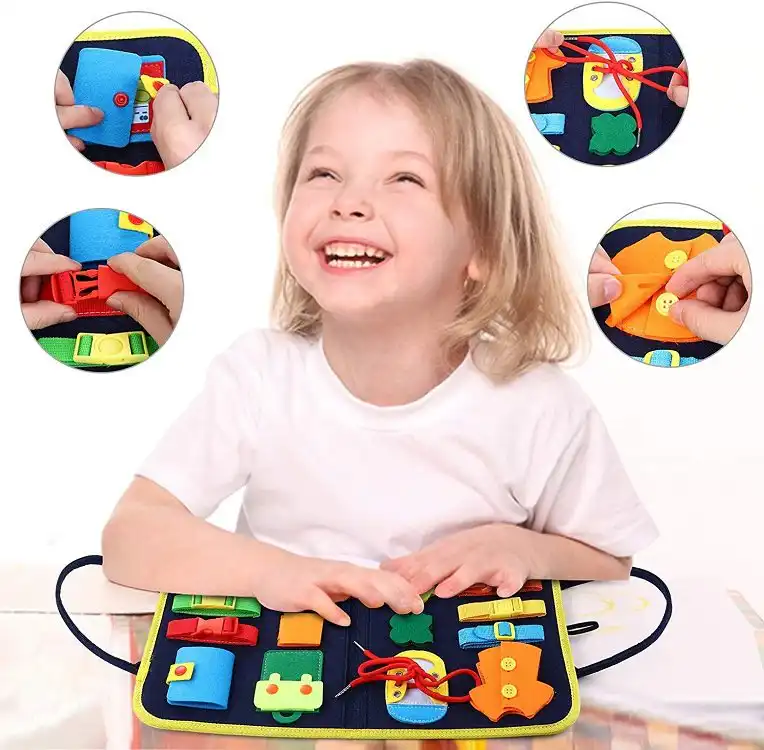
The baby's first birthday marks an emotional milestone for parents — and a major developmental milestone for the baby themselves. At 12 months, they are taking their first steps (or are about to), saying their first real words, imitating everything they see, and starting to clearly express their likes and desires. It is a whole new world opening up, and the choice of baby developmental toys 12 months must support this transformation.
At this age, toys are no longer simply objects to play with — they become tools for expression, imitation and building. Your baby wants to do «what the grown-ups do». They want to explore, create and understand. At PetitMaxou, we’ve put together this guide to help you choose toys that truly support this new stage of development — without falling into the trap of buying an impulsive «birthday present» that will only be used for a few days.
At 12 months, what can your baby do?
Before choosing, let's understand the new skills. Around 12 months, most babies:
- Are taking their first steps — some are already walking with confidence, others pull themselves up and cruise by holding on to the furniture
- Pronouncing their first meaningful words : «Daddy», «Mummy», «Auntie», «no», and often a word of their own to refer to their comfort toy
- Understand simple instructions «give me», «come», «clap your hands», «goodbye»
- Actively mimic what they see: they try to brush their hair, make a phone call, eat with a spoon
- Building intentions they know what they want and express their disagreement (sometimes with vigorous shouting)
- Stack 2-3 cubes, fit the first large shapes into place, turn the pages of a book
- Recognise images in the books and point at the familiar characters
- Developing a real personality shy, exuberant, cautious, daring — every child shows their traits
All these new features are ushering in a new era in gaming. Let’s take a look at the toys that best complement this explosion of capabilities.
The 4 major 12-month acquisitions and the toy that goes with them
1. Walking: push and pull toys
First steps usually happen between 11 and 16 months. At 12 months, some babies have already been walking for a few weeks, while others are still pulling themselves up to stand by holding onto furniture. Whatever the stage, gross motor toys play a key role in encouraging confident walking.
The push toys stables (weighted baby walkers, push-along animals, wooden trucks) offer support for first steps and give baby the independence they are looking for. For babies who are already walking well, the pull-along toys (dog, duck, train) become fascinating — baby loves watching the object follow them.
It is also the age of first wearers pedal-free (12-24 month balance bikes, foot-to-floor ride-on cars). They develop balance, coordination and prepare children for the tricycle or bicycle in later years. Choose stable models of a suitable height (feet must touch the ground comfortably).
2. Fine motor skills and construction: early assembly games
At 12 months old, baby has mastered the pincer grasp and is beginning to coordinate both hands. They can stack 2 or 3 blocks, fit simple large shapes into a sorter, and turn the thick pages of a board book. These gestures might seem ordinary — in reality, they are true motor and cognitive feats.
The wooden blocks simple ones (without magnets or complex systems) remain an unmatched classic. Baby stacks, knocks them down, starts again — and every repetition consolidates their learning. The shape sorters with 3-5 slots maximum (cube, cylinder, star) are perfect for this age; the 10-shape models are still too complex.
The first peg puzzles - those with 4-6 large pieces in simple shapes (animals, fruit, vehicles) - take centre stage. Look for large knobs on each piece to make them easier to grip. The threading toys (ring on a post, giant wooden beads) develop hand-eye coordination.
3. Language: toys that make you talk
Language explosion often begins around the first birthday. Baby says their first real words, understands more and more, and points at objects to name them. This is the time to massively enrich their linguistic environment.
The hardback books are the number one investment. Choose books with little text per page, large clear images, and themes close to everyday life (animals, vehicles, familiar objects). The flap books and the touch books add an interactive dimension that captivates baby.
The picture book makers — these books where every page shows an object clearly named — are perfect for enriching vocabulary. Read them with baby by pointing and naming: they quickly grasp the word-image link.
A few musical toys and songs (without acoustic overload) also accompany language: action rhymes, toys that make animal noises, and first musical instruments (tambourin, wooden maracas). Baby loves to reproduce sounds.
4. Social imitation: «just like grown-ups» toys»
At 12 months, baby enters the phase of social imitation. They watch what adults and older children do, and they want to do the same. It's the age when role-play toys take on their full meaning — not as a hobby, but as genuine tools for social development.
The miniature kitchens, the tea sets, the dolls and their accessories (baby bottle, brush, blanket), the doctor's first medical bags, the mops and buckets all these toys allow baby to reenact their daily life and gradually integrate social codes. These are not «girl» or «boy» toys — they interest all babies at this age, without exception.
The toy phone remains a great classic. Seeing a baby hold the phone to their ear and whisper «hello» is a touching moment that shows just how early and powerful imitation is.
Our selection of tested toys for 12-month-old babies
At PetitMaxou, we organise our selections into clear categories:
Gross motor skills and first steps
Sturdy baby walkers, push/pull toys, early ride-on toys without pedals, light balls. These toys accompany progress towards independent walking and reinforce balance.
Fine motor skills and construction
Wooden blocks, simple shape sorters, first peg puzzles, threading toys. To stimulate precision, coordination and early logical skills.
Language and early books
Board books, picture books, lift-the-flap and touch-and-feel books, and first sound books. To accompany the explosion of language and establish the bedtime reading routine.
Imitation and pretend play
Miniature kitchens, play sets, soft dolls, role-play accessories (phone, brush, utensils). To support social development and emotional expression.
First birthday gift for baby: our advice
The first birthday is often the occasion for an avalanche of gifts — and the risk is falling into over-stimulation and accumulation. A few principles for choosing a gift that truly makes an impression:
Prioritise quality over quantity. A fine, durable wooden toy, a superbly illustrated book, or a sturdy miniature kitchen will leave a much greater impression on a baby than ten little plastic toys that will end up forgotten in two weeks.
Think about evolution. A gift that will be used for months—or even years—is better than a strictly seasonal gift. Wooden blocks, for example, accompany a baby from 12 months up to 4-5 years.
Coordinate with the family. If there are several of you giving gifts, please coordinate to avoid duplicates and allow for the purchase of a wonderful group present. A quality miniature play kitchen bought together is better than five small scattered toys.
Don't forget the books. A book given for a birthday is a gift that lasts and builds a bond. Add a personal dedication — baby will read it when they grow up and keep that memory.
For more ideas, check out our article 1 year old gift: what to buy baby for their first birthday.
12-month developmental toy for girls or boys: the debate is no longer relevant
At 12 months, just like at 6 or 9 months, a baby's sex has no bearing whatsoever on their developmental needs. But at this age, one question often crops up: «Can you give a play kitchen to a boy? A toy car to a girl?»
The educational response is clear: yes, without any reservation. So-called «domestic role-play» toys (kitchens, tea sets, dolls) are essential to the social development of all babies. Construction and movement toys (cars, blocks, balls) are equally so. Restricting toys according to gender amounts to impoverishing the child's developmental environment.
Developmental psychology studies confirm this: children exposed to a diversity of toys develop better cognitive flexibility, more empathy and greater creative abilities. Conversely, children locked into «gendered» toys develop stereotypes earlier that limit their future aspirations.
Our advice: choose according to baby's clear preferences (some love cogs, others soft toys, others books) without letting yourselves be influenced by the pink/blue aisles in shops.
The Montessori approach at 12 months: encouraging independence
The Montessori approach really comes into its own at 12 months, an age when the child shows a strong desire for independence. Here are a few principles adapted to this age:
- Create a child-height space low cabinet with a few accessible toys, mini-bookshelf, dedicated rug. Baby chooses what they want, takes it out, tidies it away — they develop their independence
- Practise toy rotation leave only 4-5 toys accessible at a time, and change them every 1-2 weeks. Baby stays more focused and rediscovers the «stored away» toys»
- Encouraging everyday activities small sponge for wiping, brush for their hair, mini-spoon for eating independently. Imitation turns into real independence
- Encourage toys made from natural materials wood, metal, organic cotton, food-grade silicone. Richer tactile feel than standard plastic
- Respect their concentration when baby is absorbed in a toy, do not intervene. This capacity for sustained attention is being built right now
Babies and screens: why avoid them at 12 months (and beyond)
At 12 months, many parents begin to ask themselves the question: «can I let my baby watch cartoons? A video of nursery rhymes?» The stance of paediatricians is unanimous: no screens before the age of 3, and ideally not before 6 years of age with regular exposure.
The reasons are multiple. Screens over-stimulate a baby's immature brain, disrupt language development (which is built through human interaction, not passive viewing), reduce attention span, and accustom the baby to constant stimulation, which makes «real» play less attractive.
A nursery rhyme video during a meal may seem harmless — repeated, it has a lasting effect on a baby's relationship with attention and pleasure. The brain of a 12-month-old baby needs real interactions, hands-on manipulation, movement in space, and human faces talking and smiling. No screen can replace that.
If you occasionally give in (a train journey, a moment of extreme fatigue), don't feel guilty — it's regular exposure that's the problem, not a one-off moment. But avoid the screen «by default» as a daily way to keep busy.
Safety: the 5 traps to avoid with 12-month-old toys
At 12 months, baby moves around everywhere, opens everything, takes everything apart, and reaches new heights. Safety requires even more active vigilance:
- Mandatory CE marking on all toys — without exception
- No small detachable parts — babies dismantle things more easily at 12 months than at 9 months. Regularly check toys that have aged (stuffed toy eyes, beads, peeling stickers)
- Stable push-along and ride-on toys - a baby walker that tips over or a baby walker that is too light can cause serious falls at an age when baby is learning to walk
- Secure the environment plug guards, furniture corner protectors, drawer locks, stair gates, securing tall furniture to the wall (tipping risk)
- Caution regarding family gifts Grandparents and uncles sometimes give toys that do not meet safety standards or are intended for older children. Always check before letting baby play.
Developmental milestone timeline: the complete series from 3 to 12 months
Well done: if you are following this guide, your baby is approaching their first birthday — a milestone that deserves to be celebrated. Here is the full overview of the steps covered so far, and those yet to come:
- 3 months play mats, lightweight rattles, high-contrast cloth books. (See our 3-month-old baby developmental toy guide)
- 6 months nesting cubes, teething rings, musical toys. (See our 6-month baby development toy guide)
- 9 months baby walkers, shape sorters, first board books. (See our 9-month-old baby developmental toy guide)
- 12 months ride-ons, pull-along toys, first puzzles, role-play toys, engaging books
- 18 months and beyond complex pretend play, early creative activities (chubby crayons, modelling clay), balance bike, tricycle, early game rules
Over the months, previous toys do not disappear — they remain available for the times when baby wants to «regress» and rediscover familiar feelings. This is healthy and normal.
Frequently asked questions about the 12-month baby developmental toy
What is the best toy for a 12-month-old baby?
If you had to choose a single toy, opt for a set of quality wooden blocks: they will accompany baby from 12 months up to 4-5 years, stimulate fine motor skills, creativity, concentration, and offer an infinity of play possibilities. Supplement with a few board books and a ride-on or baby walker to have a complete foundation.
Is my 12-month-old baby not walking yet? Is that worrying?
Not at all. Walking is generally acquired between 10 and 18 months — the window is wide. As long as baby can stand by holding on and shows an interest in moving around, motor development is progressing normally. If in doubt, speak to your paediatrician at the 12-month check-up.
Should you give a miniature play kitchen to a 12-month-old baby?
If baby shows an interest in domestic imitation (tries to stir in pots, takes your spoon to pretend to eat, etc.), yes. Otherwise, wait until 18-24 months when imitation becomes more systematic. A quality play kitchen given at 18 months will be used for 3-4 years.
How many toys to have at 12 months?
Always less than you might think. 8 to 12 varied toys directly accessible, supplemented by others on rotation, are more than enough. Too many accessible toys distract baby and prevent deep play. Weekly rotation renews interest without accumulating.
Baby throwing toys: is this normal?
Totally. Throwing is an exploration of cause-and-effect and trajectory — baby is testing «if I let go, it falls». This phase naturally passes around 18-24 months. In the meantime, offer drop-resistant toys and accept that this is a developmental stage.
Is it okay to give a baby a toy that is too advanced to stimulate them?
No, it is even counter-productive. A toy that is too complex frustrates baby (they can't manage anything) and discourages them. It is better to have an appropriate toy that they master and which gives them small, regular victories. Frustration is not a driver of learning at this age.
Our selection of early learning toys for 12-month-olds at PetitMaxou
At PetitMaxou, every early learning toy is selected by our team of parents based on a single criterion: would we be happy to give it to our own child? Safe materials, developmental suitability, durability, design — nothing is left to chance.
Whether it is to prepare for baby's first birthday, add to their software library, or find an original gift for a loved one, our collection calmly accompanies this key milestone. Free delivery throughout the European Union, 14-day returns, secure payment.