





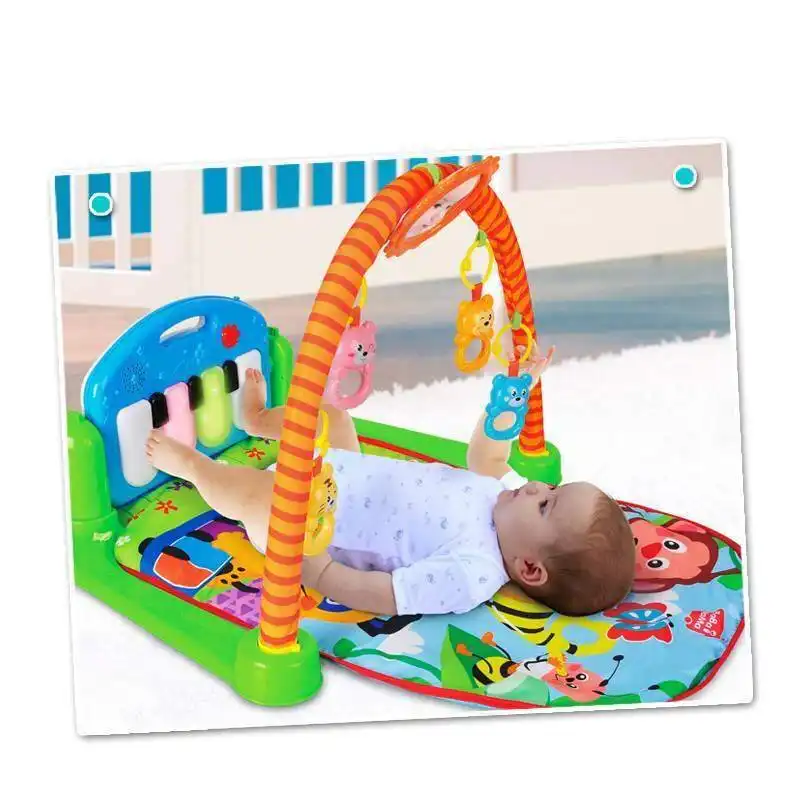
The baby playmat is undoubtedly the most-used piece of baby gear in the early months — and the most poorly chosen one. Too small, overstimulating, made from questionable materials, already outdated by 6 months: between over-designed models that serve no real purpose and cluttered mats that tire baby out, it's easy to get it wrong.
However, a good play mat supports your baby from birth right up to 12–18 months and plays a key role in their motor, sensory and cognitive development. At PetitMaxou, we’ve put together this guide to help you choose the play mat that really suits your needs — without falling for marketing gimmicks or overspending on a product that will be out of date in a few months.
What is a baby play mat actually for?
Before choosing, let's first understand what a play mat actually brings to baby. Beyond the marketing image of the «activity centre», its functions are in fact fourfold:
1. A safe space for floor-based motor skills
Baby needs to spend time on the floor, on their back and on their tummy, to develop muscle tone and prepare for sitting and then crawling. The play mat provides this dedicated zone — a clean, soft, secure space where baby can move freely without the risk of bumping themselves or slipping.
2. A sensory stimulation tool
The contrasting colours, varied textures, hanging elements, mirrors and educational toys built into the play mat stimulate baby's sight, touch and hearing. This is particularly valuable in the first 6 months when sensory development is going through a boom.
3. A trigger for hand-eye coordination
Baby gym arches with hanging toys allow your baby to grab, bat, shake and pull. These seemingly trivial actions are fundamental: they build the hand-eye coordination that will later be used for eating, drawing and writing.
4. A reassuring landmark in the home
The play mat quickly becomes «his» space — a familiar place where baby knows he can explore in complete safety. It is also a visual cocoon that reassures him while parents busy themselves around him.
From what age should you use a play mat?
The big question for new parents: do you really need a rug straight from the maternity ward?
From birth to 3 months: the contemplative phase
From the very first weeks, the play mat can be used for calm waking moments. At this age, your baby will lie on their back and look at the toys hanging from the play arches. Opt for strong contrasts (black, white, red), as these are the only colours that newborns can actually perceive. Keep the sessions short: 5 to 10 minutes at most, several times a day.
From 3 to 6 months: active exploration
Your baby is starting to reach for hanging toys deliberately and showing an interest in textures. This is the golden age of the play mat. You can also start practising the tummy time (time spent on the tummy) directly on the mat: essential for strengthening the neck and back before crawling.
From 6 to 12 months: versatile mat
Baby activity arches become less useful (baby sits up), but the play mat remains essential as safe play area. It features the first hands-on toys, fabric books and building blocks. A large play mat can then be used on its own, without the educational elements that originally came with it.
From 12 to 18 months: shock-absorbing surface
When a baby starts standing up and taking their first steps, the carpet becomes a valuable cushioning surface. Falls are less painful on a thick carpet than on wooden or tiled floors. Many parents keep their carpet in place until their child is walking properly.
To understand the complete evolution of developmental needs, please consult our series of guides: 3 month baby developmental toy and 6-month baby development toy.
The different types of play mats
Not all play mats are created equal, and depending on your needs, certain models will be more suitable than others.
The play mat with arches
The classic choice: a quilted play mat featuring one or two arches with hanging toys (stuffed animals, mirrors, rattles). Ideal for 0-6 months, it becomes less useful beyond that as baby wants to sit up and move around. Choose a model with detachable arches — you'll be able to remove the arches once baby is sitting and continue using the mat on its own.
The foam play mat (puzzle)
Made of interlocking EVA foam tiles, this modular play mat adapts to any room and is easy to put away. Very useful for 6-18 month-olds (play space, cushioning falls), it is less relevant for 0-3 month-olds who need a softer and more enveloping mat. You must check that it is labelled «formamide-free» — some cheap foams contain this controversial chemical.
The Montessori play mat
Designed in line with Maria Montessori’s principles, this play mat emphasises simplicity: no lights, no music, no overwhelming array of stimuli. Instead, it features a few carefully chosen toys (a hanging wooden mobile, a rattle made from natural materials, a shatterproof mirror) that allow baby to concentrate without becoming overstimulated. It is the go-to choice for parents who wish to prioritise quality over quantity.
The musical playmat
Featuring a floor piano that can be activated with the feet, sounds triggered by touch, and flashing lights: these ultra-stimulating play mats are commercially successful, but can tire babies out. To be used in moderation, and preferably from 4–6 months onwards when baby can understand cause and effect.
The giant play mat
XL size (130×180 cm or larger), often made from organic cotton or terry cloth, without arches but featuring printed designs (animals, shapes, letters). Very useful once your baby starts moving around a lot (6–18 months) — it offers plenty of space to play and becomes a real playground for exploration. Often cheaper than play mats with arches, and more durable in the long run.
The foldable play mat
Handy for travelling, visits to the grandparents or small spaces. Check the folding mechanism (sturdy hinges) and the thickness of the foam padding when folded — some models become rather uncomfortable.
How to choose: the 6 criteria that really matter
1. The right size for the job
A rug that is too small quickly limits baby's movements. Allow for:
- 0-6 months : minimum 90×90 cm (with arches)
- 6-12 months : minimum 130×130 cm (play area)
- 12-18 months : minimum 150×200 cm (cushioning surface)
If you want a single rug that will last, go straight for the 150×200 cm size.
2. Materials and certifications
This is probably the most important criterion. Baby spends hours on this mat, chews on it, sometimes sleeps on it — the quality of the materials is non-negotiable.
Give priority to:
- OEKO-TEX or GOTS certified organic cotton for covers and fabrics
- Polyurethane foam free from phthalates and formamide for the padding
- SGS-certified EVA foam for modular mats
Avoid cheap carpets without visible certification — they may release harmful volatile organic compounds.
3. The safety of the arch system
If you opt for a play mat with arches, check the sturdiness of the system: the arches must not detach on their own when pulled (baby pulls on them hard). The hanging toys must be securely attached and too big to be swallowed. Mandatory CE marking.
4. Washability
A play mat gets very dirty: vomit, nappy leaks, crumbled biscuits, and any other accidents. It is essential that you check:
- The removable cover and machine washable (ideally at a minimum of 40°C)
- The hand-washable padding or in the machine (depending on the model)
- The absence of impossible-to-clean areas (nooks and crannies, unprotected seams)
A non-washable rug quickly becomes unhygienic — it’s a false economy.
5. Scalability
A good playmat lasts 12–18 months. To do so, it must be able to adapt to your baby’s development:
- Removable arches for the post-6-month phase
- Large enough size for 6-12 months
- Patterns or textures that remain interesting beyond the contemplative phase
A «highly specialised» mat for newborns will only last 3–4 months — it’s a poor investment.
6. The design
A secondary but important consideration: the rug will spend several hours a day in your living room. It needs to blend in harmoniously with your interior. Rugs in neutral colour schemes (beige, sage, terracotta, off-white) stand the test of time better than ultra-colourful, «flashy primary» types.
Pitfalls to avoid
The carpet is too small
Many entry-level models measure 80×80 cm — this isn’t big enough once your baby is 6 months old. Babies move around, roll over, and quickly end up off the mat. Choose a larger one from the start.
The overstimulating mat
Flashing lights + loud music + 12 hanging toys + mirrors everywhere = a tired and irritable baby. An infant’s brain isn’t designed to process so many stimuli at once. A simple playmat with 3–4 well-chosen elements is better than a product that overwhelms the senses.
Non-certified materials
If the product description doesn’t mention OEKO-TEX, GOTS or any certification for the foam, that’s a cause for concern. Ask the seller for more information or walk away. A baby’s skin absorbs five times more than an adult’s — there’s no question of exposing their skin, which plays a key role in their development, to untested products.
The non-washable rug
Some rugs aren’t machine-washable or have areas that are impossible to clean. Avoid them at all costs — you’ll hate them after the first nappy accident.
A mat that’s too high-end for limited use
A £200-300 rug might be tempting, but it remains an investment for 12-18 months maximum. A well-chosen mid-range rug (£60-120) is better than a high-end model whose price you will regret.
Play mats and the Montessori approach
The Montessori approach to play mats deserves special attention, as it offers a radically different take on the market standard.
Montessori principles applied to the mat
For Maria Montessori, the environment should encourage the child’s concentration and independence, rather than overwhelming them with stimuli. Applied to the play mat, this means:
- Only one toy suspended at a time instead of 6 or 7 — baby can really take an interest in it
- Natural materials (wood, organic cotton, smooth metal) rather than plastic
- Contrasting but few colours (black/white/red for newborns, then primary colours)
- No music or lights — baby builds their relationship with silence and concentration
- Rotation of suspended items every 2-3 weeks to renew interest without accumulating clutter
Should you choose a Montessori rug?
This depends on your attitude towards your baby's development. If you follow the Montessori philosophy (quality over quantity, independence, calmness), a Montessori play mat makes sense. If you prefer a more stimulating and colourful environment, a traditional play mat will suit you better. Neither approach is «better» than the other — they simply cater to different sensibilities.
Safety and daily maintenance
Safety rules
- Never leave baby unattended on the mat, even during the first few weeks
- Check the fastenings regularly on the toys hanging from the arches
- Inspect the seams which can give way over time
- Remove the arches as soon as baby starts to sit up, to avoid bumps
- Avoid cushions or blankets on the mat during naps — risk of suffocation
Maintenance
- Vacuuming weekly, for crumbs and pet hair
- Washing the cover every 2-3 weeks under normal use (more often in case of an accident)
- Disinfection of hanging toys regularly (babies chew on them a lot)
- Ventilation of the padding 1-2 times a week to limit dust mites
Our selection of play mats at PetitMaxou
At PetitMaxou, we select our play mats based on a single criterion: would we be happy to use them for our own baby? Certified materials, developmental benefits, durability, and thoughtful design — nothing is left to chance.
Our models cover all uses: play mats with arches for the early months, giant mats for 6-18 months, and Montessori mats for a streamlined approach. All our mats comply with the strictest European standards and are systematically tested by our team of parents before being listed online.
Frequently asked questions about the baby play mat
What is the best play mat for a newborn?
A quilted play mat measuring at least 90×90 cm, with one or two detachable arches, made of OEKO-TEX certified organic cotton, with 3-4 hanging toys (no more) featuring strong contrasts. Avoid models with too much electronic stimulation for the first few weeks.
How long should a baby spend on their play mat?
The first few weeks: 5-10 minutes per session, 3-5 times a day. Around 3-4 months: 15-30 minutes per session depending on baby's tiredness. Beyond 6 months: as long as baby enjoys it, without forcing. Observing signs of fatigue (crying, averted gaze) remains the best guide.
Play mat or baby playpen: which to choose?
These are two complementary objects, not competing ones. The play mat is the main play space for 0-6 month-olds, and the playpen becomes relevant from 6-9 months when baby starts moving around and needs to be contained momentarily (while cooking, for example). Many parents with a playpen use the mat inside it to combine the two.
Do you need a play mat if you already have a soft sofa?
Yes. The sofa is too soft for baby's motor development: they sink into it and cannot push off to roll over or pull themselves up. The play mat offers a firm yet cushioning surface, ideal for unrestrictive movement.
Can you let the baby sleep on the play mat?
For short supervised naps, yes. For night-time sleep, no — an infant must sleep in their cot or crib, on a firm, flat mattress that complies with safety standards. The play mat is not a substitute for a bed.
Are baby play mats useful after 12 months?
Definitely. At 12-18 months, the rug becomes a valuable cushioning surface for first steps and the inevitable tumbles that come with them. Many parents keep their rug until they are 2 years old, or even longer, as a dedicated play area.
How to wash a play mat?
Depending on the models: removable cover machine washable at 30-40°C with a mild detergent, quilting to be hand-washed or spot-cleaned. Avoid the tumble dryer, which can warp the foams. Air thoroughly after washing before putting back into use.
Find the perfect play mat at PetitMaxou
Every baby is different — and every family has its own priorities. Whether you’re looking for a simple, minimalist playmat in line with the Montessori approach, a large playmat for a long-lasting play area, or a classic model with arches for the first few months, our PetitMaxou range has something to suit every need.
Free delivery throughout the European Union, 14-day returns, secure payment via Stripe or PayPal. And above all: all our rugs are selected by parents, for parents.