




When baby has a fever, every second counts — and the right baby thermometer makes all the difference. Forehead, in-ear, rectal, non-contact: given the many models available, how do you choose the one that suits your baby and your daily routine? This comprehensive guide compares the technologies to help you decide. 🌡️
🔥 Why temperature measurement is crucial in infants
Fever in an infant under 3 months old is a medical emergency — a temperature > 38°C in a baby under 3 months requires an immediate consultation. The accuracy of the thermometer is therefore not optional: a difference of 0.5°C can make the difference between simply monitoring at home and an emergency consultation.
Moreover, baby cannot tell you if they are too hot or too cold. The thermometer is your objective tool in the face of natural parental anxiety.
🔍 The different types of baby thermometers
The rectal thermometer
The gold standard in terms of accuracy according to the French National Authority for Health (HAS). Rectal measurement best reflects core body temperature. Disadvantage: invasive, stressful for baby and parents. Less and less used at home in favour of alternatives.
The tympanic (ear) thermometer
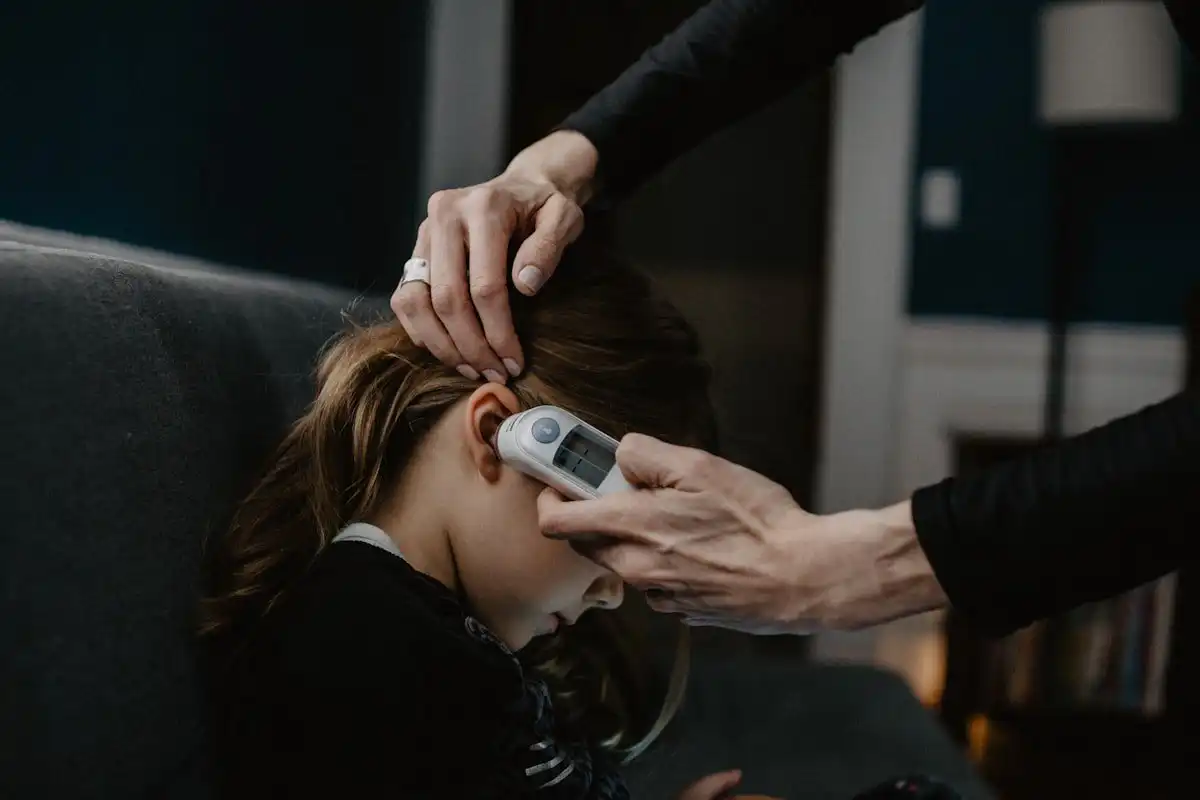
Quick (1 second), painless, fairly accurate if used correctly. Major drawback: the technique is precise — if the tip is not correctly aimed at the eardrum, the measurement is distorted. Less reliable under 6 months of age because the ear canal is too small. Requires single-use hygienic covers.
The infrared forehead thermometer
With no contact or light contact on the forehead, it measures the temperature in 1-2 seconds. Very practical at night — you can take a sleeping baby's temperature without waking them. Accuracy has improved a lot on recent models. Today, it is the preferred choice for most parents.
Our PetitMaxou infrared forehead thermometer displays the temperature in colour according to the level of fever — green (normal), amber (mild fever), red (high fever) — for instant reading even at night.
The axillary thermometer (armpit)
The most traditional and least expensive. Armpit measurement is less accurate than rectal or ear measurement — it can underestimate the actual temperature by 0.5 to 1°C. Requires baby to remain still for 1-3 minutes. Not very suitable for restless infants.
The bath thermometer
Does not measure body temperature — bath water only. Essential for checking that the water is at 37°C before immersing baby. Different from a medical thermometer.
✅ Which thermometer should I choose for baby?
Our age-based recommendation:
- 0 to 3 months rectal thermometer for situations where accuracy is critical, infrared forehead thermometer for daily checks
- 3 to 6 months non-contact infrared thermometer — practical and accurate enough for routine monitoring
- 6 months and over infrared forehead or in-ear — both are reliable and very fast
🌡️ How to interpret your baby's temperature
- < 36°C Hypothermia – consult a doctor
- 36°C to 37.5°C normal temperature
- 37.5°C to 38°C mild fever — monitoring, hydration
- 38°C to 39°C moderate fever — paracetamol if discomfort, consult if < 3 months
- > 39°C high fever — seek medical advice if persistent or if baby is listless
- 40°C paediatric emergency
Important reminder: fever in itself is not an enemy — it is a natural response of the body to infections. What matters is baby's general condition: are they active, are they drinking, are they crying normally?
💡 Tips for accurate measurement
- Always measure under the same conditions to compare — same measurement site, same time
- Wait 30 minutes after a hot bath before measuring
- For the forehead thermometer: position yourself at the side of the forehead, avoiding areas where the baby is sweating
- For the little finger: gently pull the earlobe upwards to open the ear canal properly
- If in doubt about the measurement, measure twice and take the highest value
❓ FAQ — Baby thermometer
What is the most accurate method for a baby?
Rectal measurement remains the medical gold standard. In everyday practice, a recent, good-quality infrared forehead thermometer offers sufficient accuracy for routine monitoring. For critical situations (infant < 3 months, very high fever), confirm with a rectal measurement.
Is the non-contact thermometer reliable?
Recent models of non-contact infrared forehead thermometers have an accuracy of ±0.2°C under good conditions of use. They are reliable for routine monitoring. Factors that can distort the measurement: perspiration, drafts, measuring in direct sunlight.
Do you need a different thermometer for the bath and for the baby?
Yes — they are two different instruments with distinct functions. The bath thermometer measures the water temperature (ideally 37°C). The medical thermometer measures baby's body temperature. Do not confuse them.
🛍️ Baby thermometers at PetitMaxou
Colour-coded infrared forehead thermometer, bath thermometer: PetitMaxou offers a selection of reliable measuring instruments to monitor your baby’s health. Free delivery throughout the EU.
→ See all PetitMaxou baby care accessories
To make sure you don't forget anything when out and about with baby, discover our complete changing bag checklist — the forehead thermometer is indeed one of the essentials to always have with you.
💡 Baby thermometer: common mistakes to avoid
Several common mistakes skew the measurements. Never measure right after a hot bath (wait 30 minutes) nor after intense activity. For a forehead thermometer, do not measure in direct sunlight or on a very sweaty forehead — perspiration cools the skin locally. For an in-ear one, the tip must be properly directed towards the eardrum — poor alignment can underestimate the temperature by 0.5 to 1°C. Finally, replace the thermometer batteries regularly — a thermometer with weak batteries can give erratic results without warning you.
🩺 Fever and baby: when to call 999?
For a baby under 3 months: call 999 or your GP for any temperature above 38°C. This is an absolute rule — no waiting, no «it might get better». For babies over 3 months: seek medical advice if the fever exceeds 39°C and does not respond to paracetamol, if it lasts for more than 3 days, or if the baby shows concerning associated signs (stiff neck, skin rash, breathing difficulties, inconsolability).
📋 Summary: The Essentials to Remember
To summarise this guide on baby thermometers in a few key points:
- Always choose products certified CE and OEKO-TEX for baby's safety and comfort
- Match your choice to baby's age and stage of development — what suits a newborn won't necessarily suit a 12-month-old
- Quality matters more than quantity: one or two good-quality products beat several low-end items
- If in doubt about baby's safety or health, always consult your paediatrician or family doctor
PetitMaxou selects every product according to these rigorous criteria. Our team is on hand to advise you if you're torn between several models. Free delivery across the European Union, returns accepted within 14 days.
🔗 To Go Further
Our blog is packed with practical guides to help you through the first months with baby. Here are a few related articles you might find useful: