



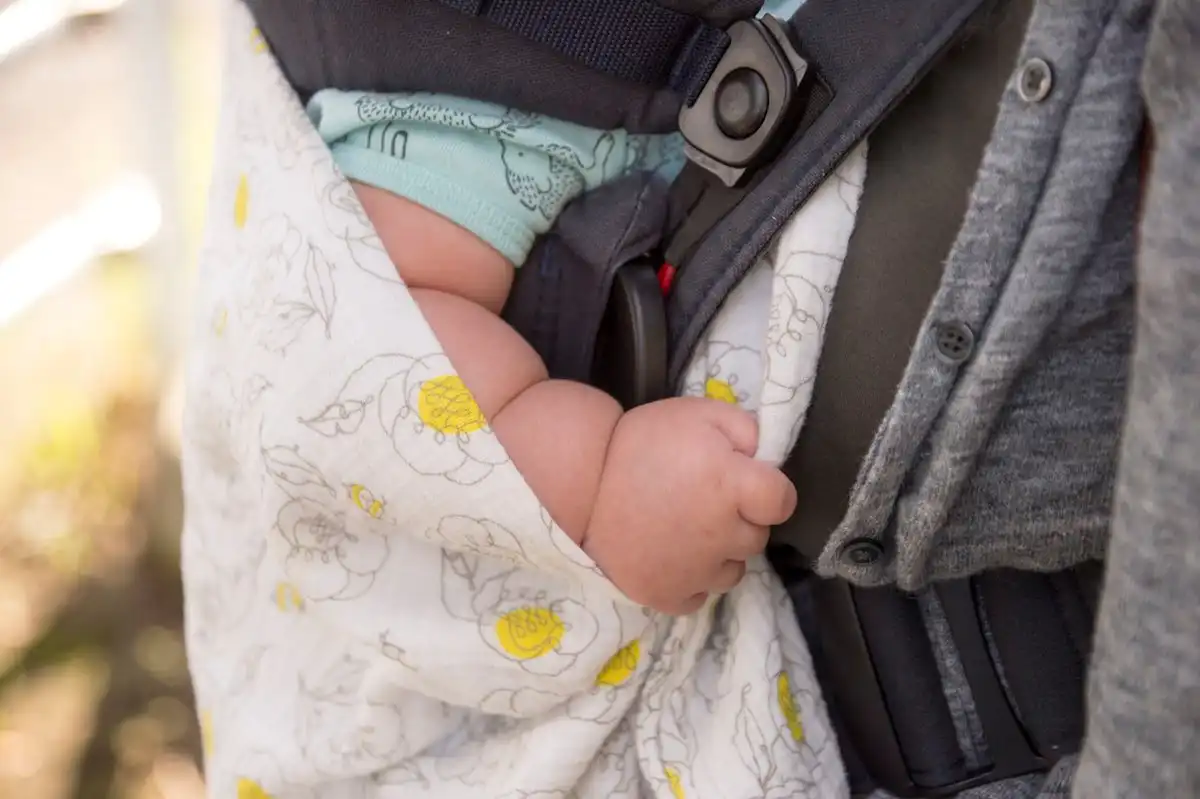
Babywearing changes parents' lives in the first few months. But faced with the multitude of models available — pre-formed baby carrier, wrap, kangaroo t-shirt, sling — it's hard to know how choose an ergonomic baby carrier which is truly suitable for baby and parents. This guide reviews everything you need to know before buying. 👶
🔍 What is an ergonomic baby carrier?
A ergonomic baby carrier is a carrying device that respects the infant's natural physiology. The fundamental difference compared to a conventional baby carrier: the position in M.
What is the M position? Baby is positioned with their hips higher than their bottom, knees bent above the pelvis, forming an «M» when seen from the front. This position — identical to that of a baby naturally carried in arms — is recommended by paediatricians and orthopaedists because it respects the development of the hips and spine, which are still forming.
Conversely, non-physiological baby carriers (where the baby hangs by the crotch with dangling legs) can promote hip dysplasia. The International Hip Dysplasia Institute explicitly recommends the M position for all baby-wearing devices.
✅ The 6 criteria for choosing the right ergonomic baby carrier
1. The position in M guarantees
That is the deal-breaker. Check that the baby carrier seat supports the baby from the backs of the knees to the buttocks — not just the crotch. The wider the seat, the better the hips are supported.
2. Back and neck support
The backrest must support the baby's entire spine, respecting the infant's natural C-shaped curve. For newborns (under 4 months), the head must be supported — either by a built-in headrest or by a newborn insert.
3. Parents' comfort
A good one ergonomic baby carrier distributes the baby's weight across the shoulders AND hips — never just the shoulders. The wide waist belt is essential for carries of more than 30 minutes. Padded, adjustable shoulder straps make it easy to share between two parents of different builds.
4. Adaptability to age
Some models start from birth (with an insert or newborn reducer), others from 3-4 months. Adaptable models accommodate up to 15-20 kg — which is 3-4 years. Check the weight limits before buying.
5. Ease of use
A baby carrier that isn't used because it's too complicated to put on is useless. The pre-formed baby carrier with buckles and adjustments is the simplest. The baby wrap requires learning. The kangaroo t-shirt is the most intuitive of all.
6. The material and the season
Light cotton for the summer, breathable materials (mesh) to prevent overheating, fleece lining for the winter. Avoid thick synthetic materials in summer — baby cannot regulate their temperature well yet.
🆚 What type of ergonomic baby carrier should I choose?
The buckle carrier (pre-formed baby carrier)
This is the most popular format. Waist belt + padded shoulder straps + adjustable buckles. It goes on in 30 seconds, is easily shared between two parents, and is suitable for long walks. The version with integrated storage is particularly practical for outings without a changing bag.
→ See the PetitMaxou baby carrier with storage pockets
→ See the PetitMaxou comfort and safety baby carrier
The pouch t-shirt
Babywearing revolution: a fitted garment with a built-in pocket. Ideal for skin-to-skin contact, the early months, and quick outings. Unisex, machine washable. The easiest to use of all babywearing systems — no knots, no buckles.
→ See the PetitMaxou T-shirt-style baby carrier
The baby wrap
The most versatile and enveloping. It adapts to all body shapes and all ages. The learning curve is real — expect a few tries before feeling comfortable. In stretchy fabric for newborns, in woven fabric for heavier babies.
→ See the PetitMaxou baby sling
The ring sling
One shoulder, two rings, a long tail of fabric. Lighter and quicker to put on than a standard wrap. Ideal for frequent transfers (taking baby out, putting them back in). Less recommended for long carries or heavy babies — the weight is on one side.
→ See the PetitMaxou ring sling
The hip carrier
Designed for babies who can sit unaided (from around 6 months). It frees up the parent's arm while keeping baby in a side-lying position. Perfect for short distances — at the doctor's, at the market, on the stairs.
→ View the PetitMaxou hip baby carrier
📅 Which ergonomic baby carrier according to baby's age?
From 0 to 4 months
Skin-to-skin contact is a priority. A kangaroo T-shirt or stretchy wrap are ideal. If you choose a structured baby carrier, check that it is suitable from birth (with an insert) and that the head is supported. Facing-in position only at this age.
From 4 to 9 months
Baby is starting to hold their head up on their own. The pre-formed baby carrier without an insert becomes usable. Some babies enjoy the outward-facing position — check that the model offers it AND that it properly supports the hips in an M position.
From 9 months to 2-3 years
Baby is getting heavier and heavier — the waist belt and wide shoulder straps are becoming essential. Back carrying (for models that allow it) relieves the parent's spine for long distances.
🛡️ The TICKS rule for safe carrying
Whichever solution you choose, check these 5 points at every babywearing session:
- TTight — the baby carrier must be snug, with no sagging
- Iin view (visible) — the baby's face must always be visible
- Cclose enough to kiss — baby is close enough to be kissed on the forehead
- Kkeep chin off chest — chin must not rest on the chest (risk of airway obstruction)
- Ssupported back (dos soutenu) — baby's back is supported in all circumstances
❓ FAQ — Ergonomic baby carrier
From what age can you use an ergonomic baby carrier?
From birth for models designed for this purpose (kangaroo t-shirt, stretchy wrap, pre-formed baby carrier with newborn insert). Always check the minimum weight indicated by the manufacturer — generally 3.5 kg.
How long can you carry a baby per day?
There is no medical limit to carrying in an ergonomic position. Some parents carry their baby for several hours a day without issue. Listen to your body — if you feel tension in your back or shoulders, adjust the setting or take a break.
Is babywearing dangerous for a baby's spine?
No, on the contrary — carrying in a physiological position is beneficial for the development of the spine and hips. It is NON-ergonomic carrying (dangling legs) that presents risks. A ergonomic baby carrier correctly used is approved by paediatricians.
Baby carrier or pushchair: which should you choose?
Both are complementary. The pushchair is practical for long outings, shopping, flat terrain. The ergonomic baby carrier is essential for stairs, public transport, difficult terrain — and for babies who need physical contact to calm down.
How do I know if my baby carrier is adjusted correctly?
A simple test: your baby should be high enough for you to kiss them on the forehead without having to bend your head down. Their knees should be higher than their bottom. Their back should be curved in a C-shape (not straight). And you should be able to slide a flat hand between your tummy and your baby’s back.
🛍️ Our selection of ergonomic baby carriers
PetitMaxou offers a selection of ergonomic baby carriers M-position approved: preformed carriers, pouch slings, wraps and ring slings for all ages and uses. Free delivery throughout the EU, 14-day returns.
→ See all PetitMaxou ergonomic baby carriers
Also to read on the blog: